



International Baccalaureate
Prepare for the future you dream of!

The International Baccalaureate (IB) is a highly rigorous and globally recognized educational program designed to develop well-rounded, critically thinking, and responsible global citizens. The IB diploma is valued by universities both in Lithuania and abroad.
At Karalienės Mortos mokykla, we strive to provide young people with as many opportunities as possible to help them achieve their highest potential and, upon completing the program, gain admission to their first-choice universities.
Karalienes Mortos mokykla is a Candidate School* for the Primary Years Programme (PYP) and the Middle Years Programme (MYP). This school is pursuing authorization as an IB World School. These are schools that share a common philosophy—a commitment to high quality, challenging, international education that Karalienes Mortos mokykla believes is important for our students.
*Only schools authorized by the IB Organization can offer any of its four academic programmes: the Primary Years Programme (PYP), the Middle Years Programme (MYP), the Diploma Programme (DP), or the Career-related Programme (CP). Candidate status gives no guarantee that authorization will be granted. For further information about the IB and its programmes, visit www.ibo.org.
In Karalienės Mortos mokykla we have been successfully teaching 11th and 12th grade students under the Diploma Programme (DP) since 2021. The aim of our School is to become an International Baccalaureate Continuum School, accredited for three IB programmes (PYP, MYP and DP) and ensuring consistent international education from Primary to High School.
The Primary Years Programme (PYP) is aimed at primary school children and aims to develop their curiosity and love of learning and focuses on holistic early childhood education that develops not only academic knowledge but also social and emotional skills. The programme focuses on values, critical thinking, creativity, problem-solving and cooperation. It is a flexible curriculum that focuses on exploration, which means that children are encouraged to seek answers to their own questions and develop skills and abilities that help them to learn throughout their lives. Learn more: ibo.org/programmes/primary-years-programme/.
The Middle Years Programme (MYP) for 11-16 year olds provides an opportunity to deepen their knowledge by bringing together different disciplines – the aim is for students to understand and appreciate how different disciplines, such as history, geography, maths, languages, science, etc., relate to each other and how skills acquired in one discipline can be applied in others. Such integration enables students to understand the interrelationships between subjects and to transfer knowledge from one subject to another. The programme is special because it strengthens students’ ability to think critically, explore and actively engage in the learning process, so that they are better prepared for the real world when they learn how to apply what they have learned in practice. Learn more: ibo.org/programmes/middle-years-programme/.
The Diploma programme (DP) is aimed at 16-19 year olds and focuses on preparing them for university and career planning. It develops their critical and analytical thinking, helps them to acquire in-depth academic knowledge, and fosters a wide range of skills such as autonomy, problem solving and ethical judgement. In addition to the core academic subjects, students produce an Extended Essay, participate in Creativity, Activity and Service (CAS) projects, and delve into the nature of knowledge through a Theory of Knowledge (TOK) course that develops critical thinking and analytical skills. Learn more: ibo.org/programmes/diploma-programme/.
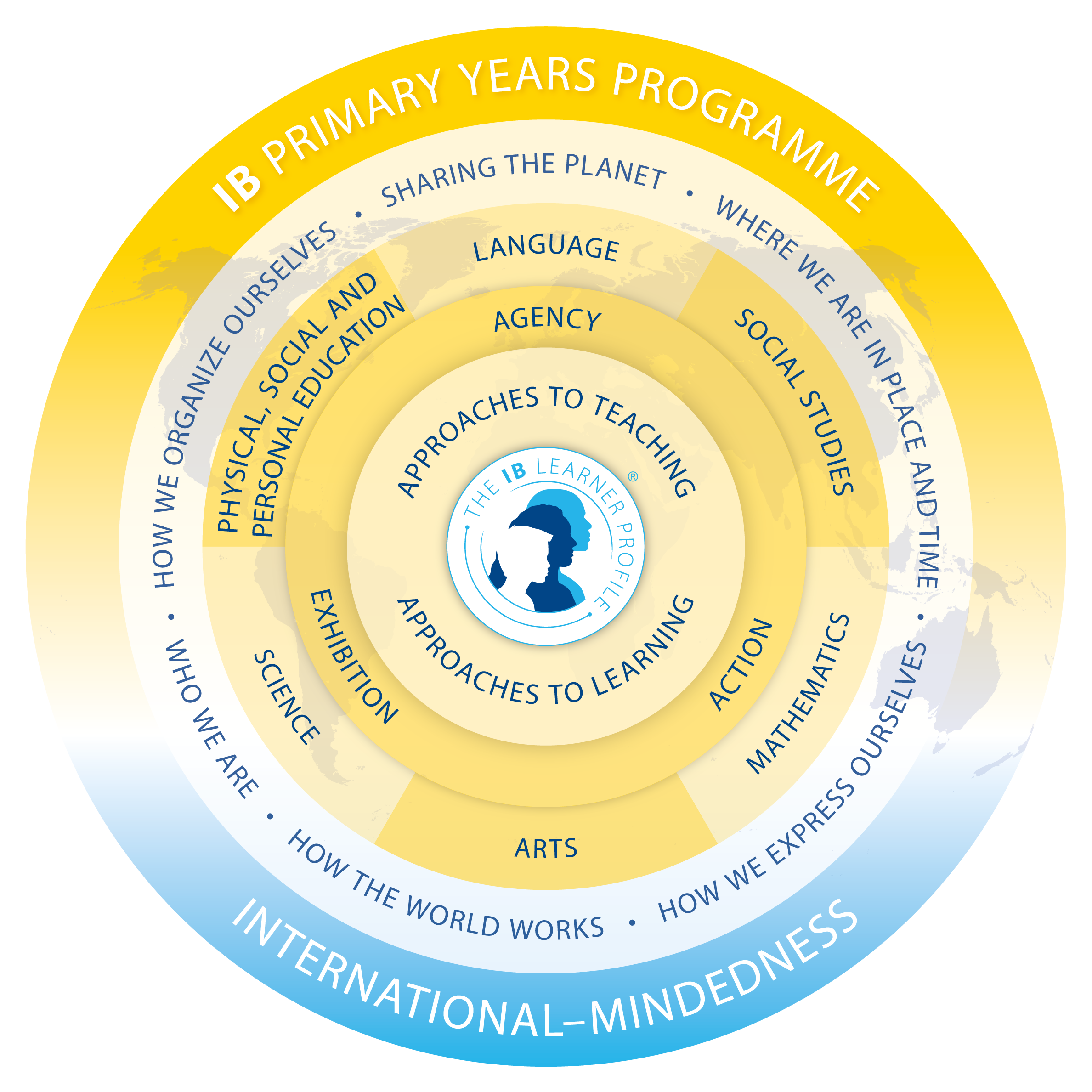
The International Baccalaureate (IB) organization uses program models to clearly and visually show how programs are structured and what goals they aim to achieve. Each model shows that IB education is not just about subjects—it also encompasses skills, values, and holistic personal growth. Why this is important:
Clarity and communication. The models help students, parents, and teachers quickly understand the direction of each program and how learning is organized.
A holistic view of learning. IB education encompasses not only academic disciplines but also personal development: internationalism, learner profile, learning skills, and values.
Program consistency. All models emphasize common IB principles – inquiry, a global learning context, and a student-centered approach. At the same time, each model highlights its own uniqueness:
- PYP (Primary Years Programme) – develops curiosity and inquiry skills, emphasises learning through interdisciplinary themes.
- MYP (Middle Years Programme) – connects knowledge with real-world contexts, strengthens critical thinking and project-based activities.
- DP (Diploma Programme) – provides academic depth and breadth, combining subjects with elements such as Theory of Knowledge, Extended Essay, and CAS activities.
Guidelines for schools and teachers. The models serve as frameworks for planning teaching content, assessment, and educational strategies, ensuring consistency with the TB philosophy.
The student is at the center. In all models, the student is at the center, emphasizing that IB education is primarily focused on the student and their growth, rather than just on the delivery of content.
© International Baccalaureate Organization 2018
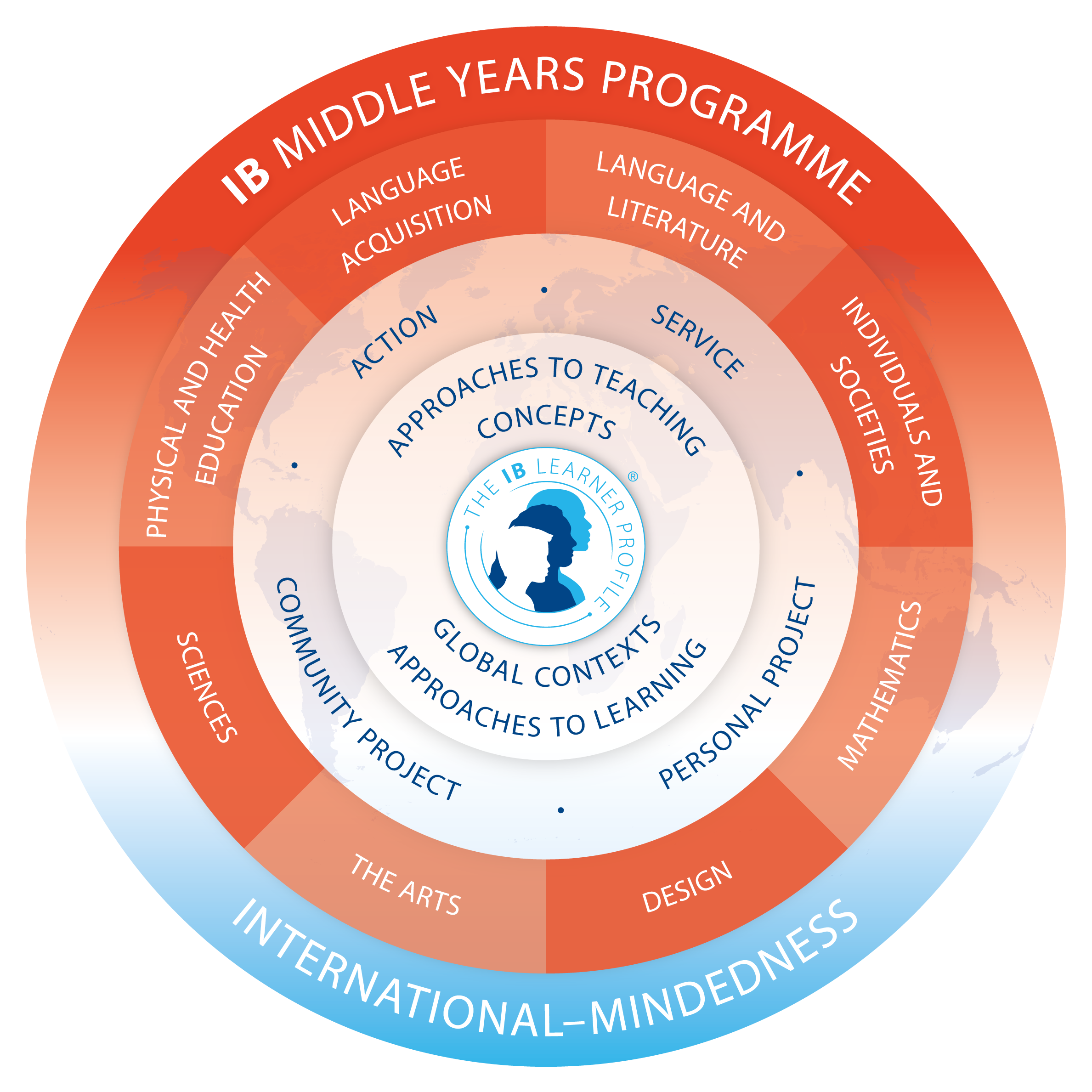
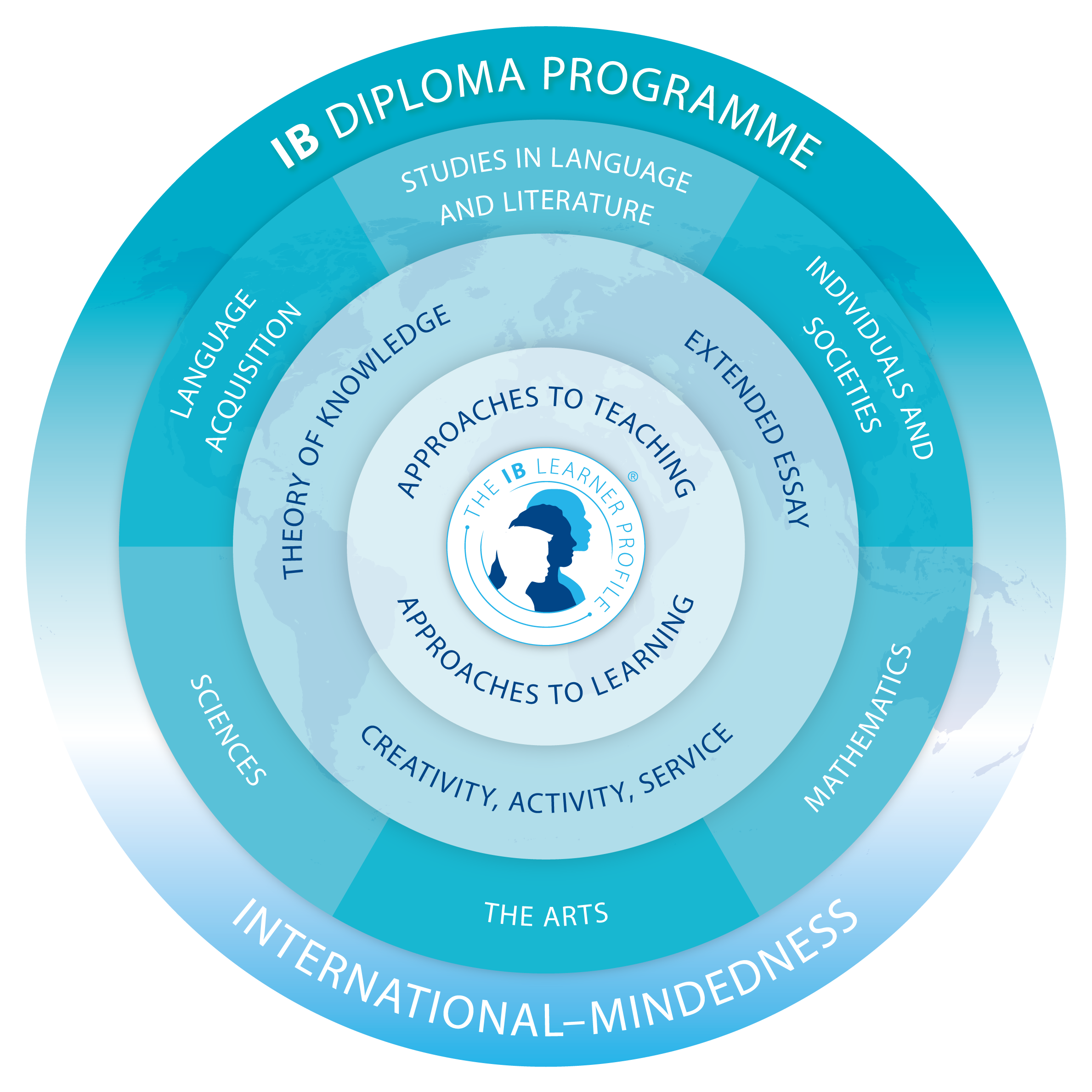
The International Baccalaureate aims to develop curious, knowledgeable and caring students who will contribute to a better and more peaceful world based on intercultural understanding and respect. For example, in daily activities, pupils are encouraged to work in groups, solve real-life problems and create projects that promote care for the environment and the community. This fits well with Karalienės Mortos mokykla vision of educating “courageous and lifelong learners”. We always prioritise fostering a culture of thinking, encouraging students to question, explore and develop a love of lifelong learning.
At Karalienės Mortos mokykla, we aim not only to provide a strong academic foundation, but also to develop a well-rounded personality, so character education is an integral part of our educational process – we are guided by values such as respect, creativity, courage, sensitivity, resilience and adaptability. We teach students to learn about the world, not just about their own country, by developing respectful, diverse and responsible global citizens. We foster academic excellence, create a culture of thinking and strengthen the individual strengths that students possess.
Watch the following videos to learn more.

At Karalienės Mortos mokykla and within the IB PYP, we pursue the same goals: to nurture curious learners who demonstrate knowledge, critical thinking, and caring, and who contribute to creating a better and more peaceful world.
Since the founding of Karalienės Mortos mokykla, we have followed educational principles that closely align with the PYP philosophy: in every year group, students explore six transdisciplinary themes that integrate different subject areas, helping children see the connections between them. Students also engage in annual projects. We emphasize to our students that what matters is not only the outcome but also the learning process itself. This approach reflects one of the core elements of the IB programmes – inquiry-based learning.
The philosophy of the PYP values not only integrated learning but also collaboration, which is why teachers at KMM engage in regular interdisciplinary and collaborative planning. This develops an understanding of multiple perspectives on learning and helps create meaningful and engaging learning experiences for students.
The mission of Karalienės Mortos mokykla is to provide international education for children in Lithuania. This is why we teach in Lithuanian and foster a strong sense of civic responsibility. International programmes at our school strengthen the quality of learning and open up even more opportunities for students. However, even after receiving authorization for the IB Primary Years Programme (PYP) and Middle Years Programme (MYP), we will maintain our distinctiveness – a strong focus on citizenship education and our motto “Local school, global education”. In our Primary and Middle Schools, teaching will continue in Lithuanian, while the IB Diploma Programme (DP) will be delivered in English, as it has been until now.
We will continue to place strong emphasis on citizenship education, and our values and Lithuanian identity will remain central, as they are an essential part of a global citizen’s identity. Lithuanian identity and the understanding of oneself as a global citizen are two core values that complement each other. The International Baccalaureate supports students in becoming conscious global citizens who understand global challenges, respect cultural diversity, and act responsibly in a global context. We believe that our students will grow up with confidence, pride in their Lithuanian heritage, and a commitment to contributing to the future of both Lithuania and the wider world.
The International Baccalaureate (IB) Primary Years Programme (PYP) promotes a holistic approach to education and aims to develop well-rounded individuals – fostering not only academic knowledge but also the social and emotional skills that help children thrive in an ever-changing world.
Each year, students explore six transdisciplinary themes, which integrate multiple subject areas. This enables children to make connections across disciplines and apply their learning to real-life contexts.
At the heart of the PYP is inquiry-based learning, which encourages students to ask questions, seek answers, investigate, and think critically. This approach nurtures curiosity, creativity, and a lifelong love of learning.
In the International Baccalaureate (IB) Primary Years Programme (PYP), children learn to explore the world through curiosity and reflection. Parents can support this process at home – sometimes a single thoughtful question can spark an entire cycle of inquiry. Instead of offering quick answers to the questions children often ask, try responding with another question, such as “What do you think makes it work?” or “How could you find that out?” And instead of simply asking “How was your day?”, try “What did you learn from this experience?”
We invite parents to become partners in their child’s learning journey – to explore together, support their decisions, and, most importantly, help them understand that in learning, the process is just as important as the outcome.
By encouraging inquiry and reflection, we help children develop confidence, independence, and a lifelong love of learning. True learning happens not when every question is answered, but when children learn to ask bold and meaningful questions.
Let children be the inquirers – and let’s be their inspiration!
The aim of the IB Middle Years Programme (MYP) is not only to deepen knowledge, but also to connect different disciplines so that students understand the world as an interconnected whole rather than a collection of separate lessons.
For example, in geography students explore climate change, while in science they investigate its impact on the environment and ecosystems. In mathematics, they learn to analyze data on global demographic shifts, while in history they examine how these changes have influenced migration or conflict.
This way of learning allows students not only to retain facts, but also to apply knowledge in real-world contexts. They learn to identify connections, analyze, think critically, and approach problems with creativity. Such interdisciplinary learning helps students develop a deeper understanding of subject areas and prepares them for life in a modern, constantly changing world.
At Karalienės Mortos mokykla, we place strong emphasis on both acquiring knowledge and universal learning tools. We work with the Approaches to Learning (ATL) framework to help students become independent, learn effectively, and apply their knowledge across a variety of contexts. The International Baccalaureate identifies key groups of skills that are cultivated in all subject areas and activities. These skills equip students with the abilities necessary for success in both learning and life. They are organized into five categories:
- Thinking skills – analyzing, evaluating, and solving problems creatively.
- Research skills – locating, evaluating, and processing information.
- Communication skills – expressing ideas clearly, both orally and in writing.
- Social skills – collaborating, listening to others, and working effectively in teams.
- Self-management skills – planning time, managing emotions, and setting and achieving goals.
The development of these competencies supports Karalienės Mortos mokykla mission: to nurture courageous, lifelong learners who are able to think critically, communicate clearly, collaborate, take risks, and accept responsibility. We strive to develop well-rounded individuals who understand global interconnections, are prepared to support others, and are committed to building a more peaceful world.

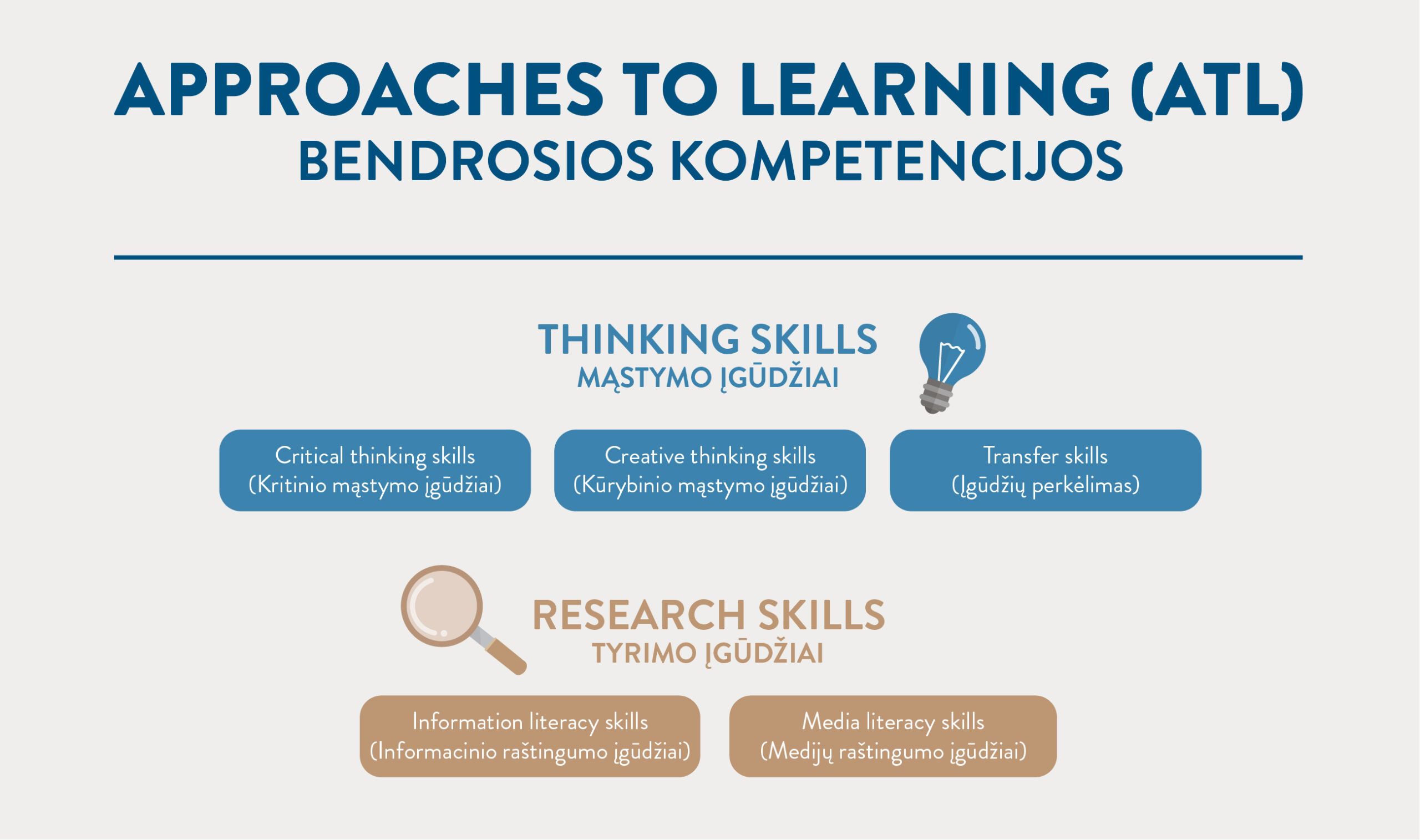
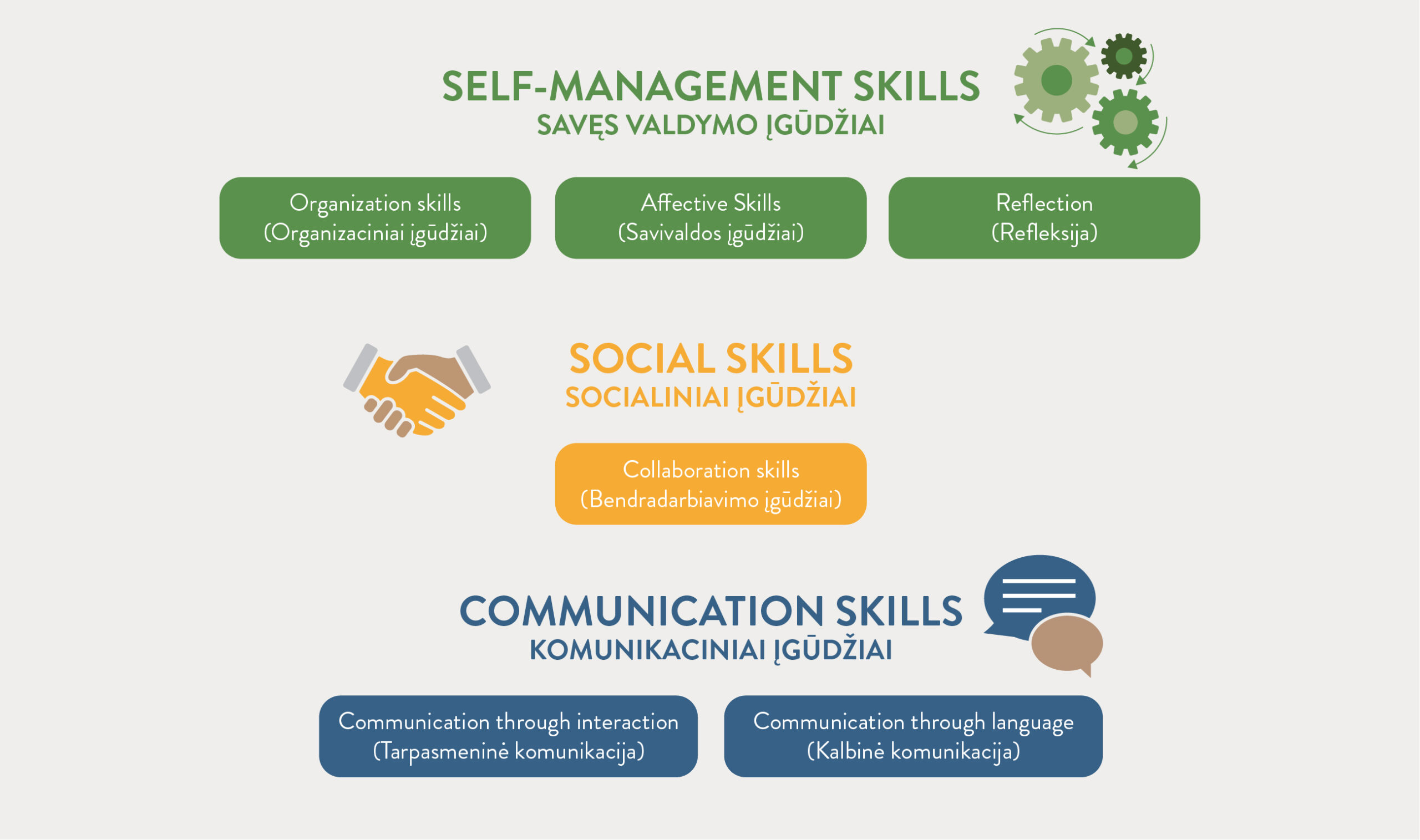
The International Baccalaureate student profile describes 10 attributes that are valued by IB schools worldwide. The goal of all IB programmes is to develop individuals with an international perspective who are community-minded, aware of their responsibility for the future of our planet, and contribute to the creation of a better and more peaceful world.

They nurture their curiosity, developing skills in questioning and conducting research. They know how to learn independently and with others. They are eager learners and engage in lifelong learning.

They are able to understand and apply theoretical knowledge in practice, with an interest in various disciplines. They engage in solving local and global issues and implementing ideas.

They apply critical and creative thinking skills to analyze and solve complex problems. They are proactive in making reasoned, ethical decisions.

They are creative and able to communicate confidently in various ways and languages. They collaborate effectively and listen attentively, considering the perspectives of others and groups.

They act with honesty and integrity, guided by a strong sense of justice and fairness. They respect the rights and dignity of all people. They take responsibility for their actions and their consequences.

They analyze and critically evaluate both their own culture and personal histories, as well as the values and traditions of others. They are interested in different perspectives, analyze them, and are open to learning from experience.

They are empathetic, compassionate, and respectful. They engage in social activities and take initiative to create positive changes for both those around them and the world at large.

They face uncertainty with determination and are prepared for it; they work both independently and collaboratively to discover new ideas and innovative solutions. When confronted with challenges and change, they are resilient and able to find creative solutions.

They understand that, to achieve their own and others’ well-being, it is important to balance intellectual, physical, and emotional aspects of life. They recognize their connection to others and the world in which they live.

They thoughtfully consider the world, its phenomena, and their own ideas and experiences. They understand their strengths and weaknesses in order to learn and grow effectively.

Subject Selection and Levels
In the IB programme, students are required to study six subjects — choosing one subject from each group.
They select their subjects based on their interests, strengths, and intended future studies.
Three subjects must be chosen at the higher level (HL), and the other three at the standard level (SL).
Over the two years of the IB programme, higher-level courses involve 240 hours of instruction, while standard-level courses involve 150 hours.

Language of Instruction
The entire International Baccalaureate Diploma Programme is taught in English. Only Lithuanian literature lessons are conducted in Lithuanian.
Lithuanian Literature
English Language and Literature (English A)*
*Students who do not speak Lithuanian (those arriving from abroad) study English Language and Literature as their Group 1 subject. They then choose Spanish from Group 2.
Students whose native language is Lithuanian choose Lithuanian Literature for Group 1 and may select either English Language or English Language and Literature for Group 2.*
English Language and Literature (English A)
English Language (English B)
Spanish Language (Ab initio)
History
Psychology
Geography
Economics
Global Politics
Biology
Chemistry
Physics
Environmental Systems and Societies
Analysis and Approaches
Analysis and Interpretations
As their sixth subject, students must choose one subject from Group 2 (Spanish), Group 3, or Group 4.
All students pursuing the International Baccalaureate Diploma must additionally complete these three compulsory activities: write an Extended Essay, study the Theory of Knowledge (TOK) course, and carry out a project as part of the CAS (Creativity, Activity, Service) programme.
In the IB philosophy, these three components are known as the core elements, aimed at broadening students’ academic experiences and providing opportunities to apply their knowledge and skills in practice.
In the Theory of Knowledge (TOK) course, students are asked to reflect on the nature of knowledge and explore the question: how do we know what we claim to know?
Students learn to understand and critically evaluate different ways and areas of knowing, ask questions, assess information sources, formulate arguments, and express their opinions. Throughout their studies, they also:
- gain a clearer understanding of the multilayered nature of the knowledge process,
- identify and assess their own assumptions,
- develop the ability to recognize different perspectives,
- make insights in areas they had not previously considered,
- evaluate the connections between academic subjects,
- enhance their critical thinking and analytical skills.
This is a 100-hour course integrated into other subjects (two lessons per week).
Theory of Knowledge is assessed through an oral presentation and a 1,600-word essay written by the student.
It is an independent scientific research project (a 4,000-word essay) that each student writes on a topic of their choice, under the supervision of a subject teacher.
Through this work, students not only deepen their knowledge in an area of interest but also gain practical preparation for university studies: they learn to formulate appropriate research questions, engage deeply with a topic, and express and argue their ideas.
Approximately 40 hours are dedicated to this independent project.
This is a fundamental and unique part of the IB programme, aimed at developing a wide range of student skills.
It helps students view extracurricular activities as an integral part of daily life — through participating, students learn to balance academic work with other activities that foster personal growth.
Students engage in various activities and initiate and implement personal or community projects. Projects may focus on one area or combine two or all three CAS strands:
- Creativity — artistic and other activities that develop creative thinking.
- Activity — sports or other activities that promote healthy lifestyle habits.
- Service — voluntary activities that foster students’ social competencies and care for other community members or the environment.
DIPLOMA REQUIREMENTS
To complete the International Baccalaureate Diploma Programme, students must successfully fulfill the following requirements:
- Study and complete 3 subjects at the higher level (HL).
- Study and complete 3 subjects at the standard level (SL).
- Complete the Theory of Knowledge (TOK) course.
- Submit an original Extended Essay (EE) of 4,000 words.
- Fulfill an individual plan for Creativity, Activity, and Service (CAS) activities.
EXAMINATIONS
Students must take final examinations in all six subjects. The exams are prepared and assessed by the external International Baccalaureate Organization (IBO).
Achievement in each subject is graded on a scale from 1 (poor) to 7 (excellent). Students must earn at least 24 points from the exams. The maximum possible score for the diploma is 45 points.
Higher-level and standard-level subjects are weighted equally in calculating the overall diploma score.
This means that a score of 6 in a standard-level subject is just as valuable as a score of 6 in a higher-level subject.



Opens doors
The IB diploma offers broader opportunities. A student who successfully completes the IB Diploma Programme is highly sought after by the best foreign universities, as the IB diploma is recognized as meeting a high-quality internationally recognized education standard. Research has shown that IB DP students demonstrate better readiness for university studies and adapt well to the demands placed on students.
Students develop excellent language skills
Students who are proficient in English have access to a wealth of information resources, communicate effectively, engage in international issues, and have a wider choice of studies after school.
Students unlock their potential
This dynamic programme sets high academic expectations for students, encourages them to embrace new experiences, step outside their comfort zone, set goals, and face challenges and mistakes, helping them grow every day.
Students choose what they study
The Diploma Programme allows students to choose subjects based on their interests, academic ambitions, or identified personal strengths.
Holistic approach to teaching
The programme requires high motivation, academic perseverance, and engagement, but it also aims to ensure a balance between academics and other activities, providing opportunities for students’ creative pursuits, self-development, and responsible involvement in local or international community activities. The programme teaches students to assess their strengths and develop personal qualities that challenge them.
Empowers lifelong learning
Thanks to its dynamism, consistent learning, and high academic expectations, the programme significantly enhances students’ ability to learn independently, strengthens exceptional learning skills, and develops students’ work ethics and personal responsibility.






Gabrielė Kaupaitė,
Karalienės Mortos mokykla PYP programme coordinator
gabriele.kaupaite@kmmokykla.lt
Lolita Zagurskaitė,
Karalienės Mortos mokykla MYP programme coordinator
lolita.zagurskaite@kmmokykla.lt
Virginija Barbaravičiūtė,
Karalienės Mortos mokykla DP programme coordinator
virginija.barbaraviciute@kmmokykla.lt